
Will Luke Williams change Posh’s formation, and should he?
Luke Williams arrived at Posh with a settled squad, a season already in trouble, and very little room for a grand tactical reset.
This summer gives him a chance to shape the side in his own image (as far as the club allows him to). The retained list has already taken a serious chunk out of the squad, with 14 players either transfer listed, released or returning to parent clubs.
If Williams wanted to overhaul the formation, the time would be now.
Williams has spoken positively before about the wing-back shape he used at Notts County, while also making it clear he is not tied to one system.
Since arriving at Posh, the wider message has been more about principles: possession, attacking football, goals, and being aggressive without the ball.
But changing formation isn’t just about backing a manager. It :
changes the types of players you need to buy and lock into multi-year contracts,
changes the career trajectories of players you’ve already invested in
depending on the formation, shrinks the pool of clubs who’d be interested in buying your players (whether you’re trying to offload them, or sell for millions.)
It also might not be the biggest issue.

What was the Notts County shape?
The best breakdown of that side is this Total Football Analysis piece. Their preferred formation was a 3-4-2-1, built around possession dominance, wide rotations, attacking centre-backs and wing-backs who acted as wingers.
On paper, the shape looked like this:
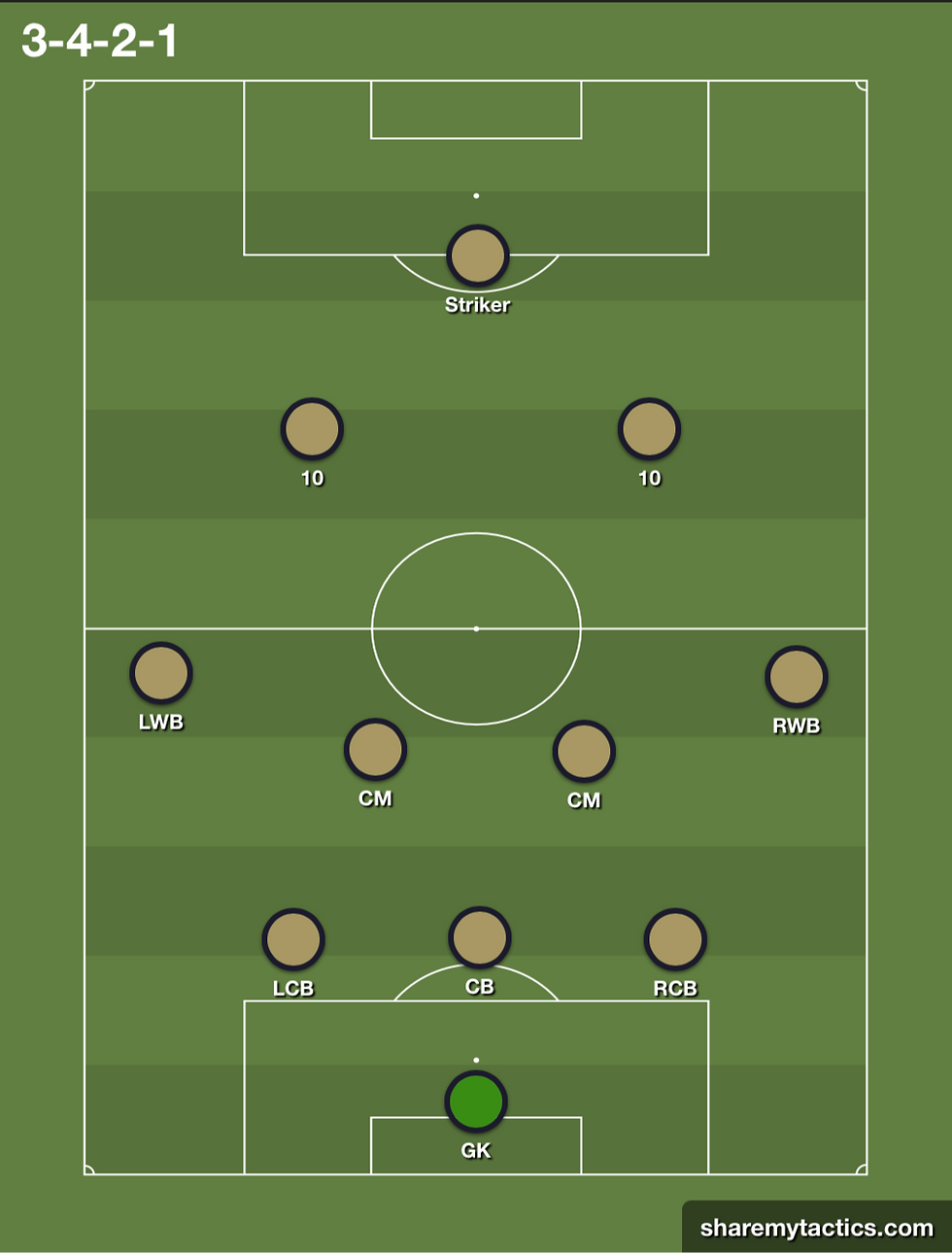
This is where the “back five” label becomes a bit misleading. Notts were not playing a defensive game. They outscored Wrexham in the National League that season with 117 goals, had an average of 69% possession, and the wing-backs scored 12 between them.
The back three gave them a platform to push players higher, and dominate possession while passes create angles through the pitch.
Those angles were crucial. Their wide centre-backs were important in punching the ball into midfield areas or dribbling forward themselves. It also highlights the rotation between the wing-back and attacking midfielder:
if the wing-back stayed wide, the attacking midfielder came inside;
if the attacking midfielder moved wider, the wing-back adjusted around him.
10
/ \
RCB ---- RWB
The wide centre-back can pass into the 10, play outside to the wing-back, or carry forward himself. A CM can drop and cover, or provide another option.
Once an opponent jumps, the next pass opens. It gives the team three different ways to progress from the same side of the pitch.
When Notts pushed teams back, the attacking shape looked more like this:

So, the wing-backs need to be closer to wingers than full-backs (though in the Notts system, both were converted full-backs), the CM’s need to be very technically gifted for the level, the CB’s need to be very comfortable on the ball and quick enough to cover wide area’s, and the front three, the 10’s and the 9, need to be fluid in their movement.
Does it fit this Posh squad?
At the moment, not really.
Centre-back is the first issue. Sam Hughes could be the centre of the back three. He is better on the ball than some think, but I wouldn’t back him to cover the ground needed to be a wide CB in a three.
Dave Okagbue has played well enough at LCB in a four, but ideally you’d have a left footer in a back three, and someone much better on the ball.
George Nevett, our best on-the-ball CB who’s shown real promise in a back three, has been made available for transfer.
Then there’s wing-back. Adebisi, bless him, can't be relied on to play regularly, or maybe ever. Mills could be a good option as a wing-back. On the other side, Carl Johnston and James Dornelly do not scream wing-back naturally. However, Dornelly’s best attacking performance in a Posh shirt was a wing-back (albeit against a U-21 side).
Williams has already tried a version of his 4-2-3-1 where Dornelly inverted from full-back to help form the extra midfield line. Likely to create some of those passing angles mentioned above. It did not work so well, and to be honest, I think Mills might be more suited to that role.
In CM, Khela and Woods might be able to play those roles in this system. But you’d need a far more ball secure, deep lying playmaker type to knit everything together in the way Williams would want, as John Bostock in the Notts system did.
Matty Garbett looks like one of the more natural fits for the inside-10/advanced-midfield part of the system. However, I would be very surprised if he were at Posh next year.
Other options are very thin on the ground. We’re looking to sell basically the rest of our attacking midfielders. Kyrell Lisbie could potentially fit into this better than some might think. He’s more of a run-in-behind, get-into-the-box winger than he is a creative one anyway. It’s still a bit of an awkward fit on paper, though.
Harry Leonard would thrive in any system as a nine, he’s just so good in League One.
Of the players we will be building around, have invested money in, and have long contracts next season, it’s not a natural fit for most.
Does it fit the club?
Posh are a selling club (I would argue every club not called Real Madrid or Barcelona is a selling club). Tactics cannot be separated from that.
The club needs to win games, of course, but it also needs to develop players who make sense to the next buyer, as is our sustainability model. A winger in a 4-2-3-1 is easy to judge. A full-back in a back four is easy to judge. A centre-back in a pair is easy to judge. More clubs play 4-2-3-1’s, or 4-3-3’s or some variation thereof.
A wing-back-only profile narrows that. A narrow 10 in a 3-4-2-1 might be excellent for Williams, but the next club then has to decide whether he is a winger, a midfielder, a second striker or something between the three.
Good players still sell, and Posh should not become frightened of interesting football. The club also cannot afford to build bland, flat teams just because every role is easily understood by a future buyer.
The balance is the thing. A very specific formation can work when the recruitment is precise, and the manager stays long enough to develop it.
It can also leave a club with too many specialists if the results fall off, injuries hit, or the next recruitment cycle moves in a different direction. Notts are also committed to that system and have played it ever since their last takeover, and have ensured every manager they have appointed is on board with playing it too.
Can Williams get the same ideas from a back four?
Williams does not need to abandon his Notts ideas just because he plays a 4-2-3-1. If we assume the 4-2-3-1 stays, from there, Williams can still try to build the box midfield in possession.
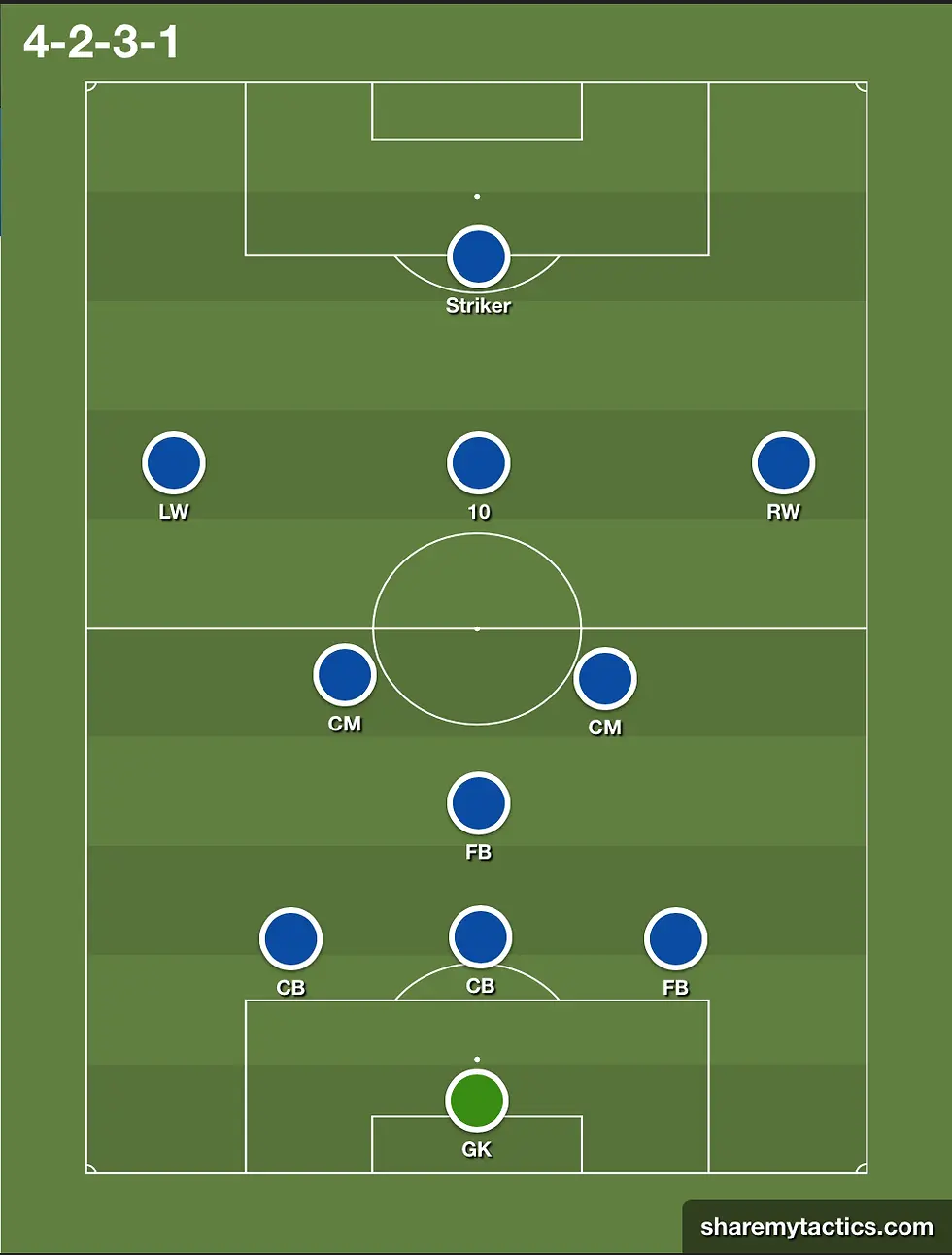
This is broadly the idea behind using an inverted full-back. One of the full-backs steps inside, joins the midfield line, and helps form the box behind the front players.
Dornelly has already been used in that sort of way. The problem was that it did not look especially natural. I would argue that it would take better players (or, being generous, more practice) for Dornelly, our CM’s and RW’s to get it right.
There is another version where the movement comes more from the midfield and the wide players.

That may suit Posh better. It keeps the full-backs closer to roles they understand, lets one midfielder sit and screen/ drop into the back three, the other midfielder push on, and keeps proper width with wingers, not wing-backs.
So, will he change it?
I would be surprised if it’s a wholesale formation change. Though increasingly, I feel I might be alone in that.
While Williams best work came with a 3-4-2-1, our full-backs don’t seem suited to it, and aren’t transfer listed, while our best ball-playing CB is, and none of them seems suited either. Our CMs, best non-striker attacker, isn’t either. We’d need three new CB’s and two new 10’s at least.
It might not factor into the club's thinking (Darragh does love Luke after all), but Williams also has less capital to make such a radical change. The end of the season was so dire that while I certainly, and I think most Posh fans, still back Williams, a bad start to the season could be terminal.
The success of and style of play isn’t all about formation, either. Lincoln and Cardiff both played a 4-2-3-1 shape for most of the season, and you will not find two more totally different styles of play.
There are also far more obvious issues. Formation is irrelevant if our out-of-possession, pressing system and stats are as bad as last year. Who cares if it’s a back three or back four, if no one is running or putting a tackle in.
Posh were 24th for tackles per match, 22nd for interceptions per match and most worryingly, 23rd for possession won in the final third in League One last season, per FotMob. We can fix that and create the style of play Williams wants, without gambling on a formation that would be tough to undo.
There are more foundational issues in the squad than the formation they line up in.


Comments